





















Let’s be honest: A-Level Economics is a big step up. The concepts are more abstract, the diagrams are more complex, and suddenly, you’re expected to have an opinion on the global economy. It’s no longer just about defining “opportunity cost”—it’s about applying it to real-world trade policy, market failures, and economic shocks.
Navigating this new territory requires a good toolkit. Your textbook and your teacher are your foundation, but to really excel, you need to build on that. The good news is that there’s a wealth of incredible (and often free) resources out in the wild.
Here’s a breakdown of the essential resources, from digital hubs to video gurus, that will help you build your understanding, refine your exam technique, and maybe even start thinking like an economist.
💻 The “Must-Bookmark” Websites
 These sites should be your first port of call for revision. They are the holy trinity for notes, case studies, and practice.
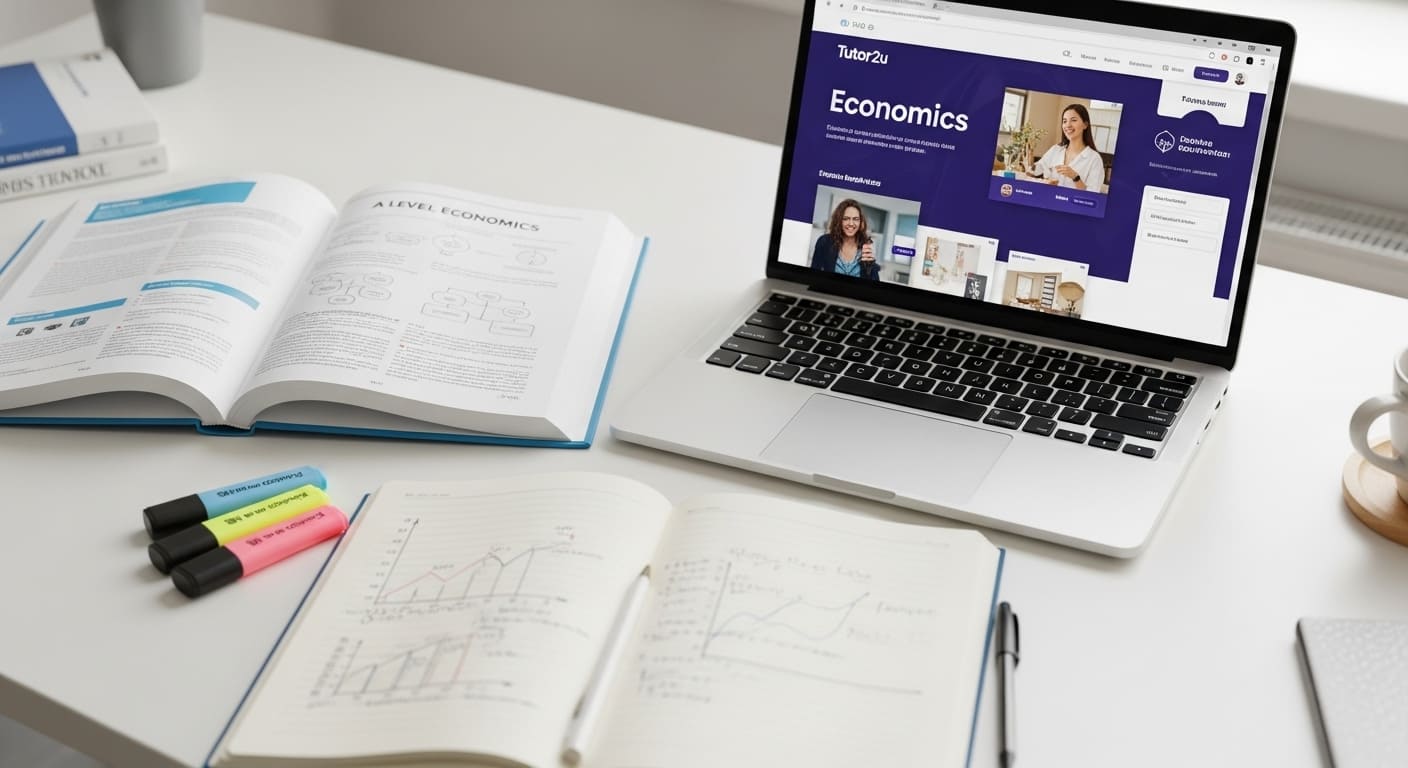
- Tutor2u: If you haven’t found Tutor2u yet, you’re in for a treat. It’s a vast, comprehensive library built specifically for UK A-Level students. They have detailed study notes on every single topic, from the basics of scarcity to the complexities of quantitative easing. Their daily blog is also fantastic for finding contemporary examples and “synoptic” links (those all-important connections between different parts of the syllabus).
- The Economics Tutor (TET): This one is a top-tier A-Level Economics tuition centre (primarily for the Singapore-Cambridge A-Levels, which shares roots with the UK system). While it’s not a free-for-all notes site, it represents the high-value, structured resource route. This service provides students with a comprehensive ecosystem of materials, including in-depth study guides, extensive collections of model essays, past A-Level questions and suggested answers, and proprietary answering techniques built from years of teaching. It’s a prime example of a resource focused on structured learning, exam strategy, and providing polished, ‘A-grade’ answers to use as a benchmark for your own work.
- Economics Help: Run by economist Tejvan Pettinger, this site is a goldmine for clear, simple explanations of complex ideas. If you’re struggling with a concept (e.g., “What is the multiplier effect, really?”), chances are Economics Help has an article that will make it click. It’s less flashy than Tutor2u, but the clarity is unmatched.
📺 The YouTube Gurus
 Sometimes, you just need someone to explain it to you. These channels have saved countless students’ grades by breaking down tough topics with clear diagrams and examples.
- The Go-To: EconPlusDal
If there’s one channel you subscribe to, make it this one. EconPlusDal is widely considered the “go-to guy” for A-Level Economics. His videos are energetic, thorough, and laser-focused on the A-Level specification. He excels at walking you through diagrams step-by-step (e.g., drawing a negative externality diagram and showing the policy impact) and provides brilliant real-world examples that you can use in your essays. - The University Power-Up: Marginal Revolution University (MRU)
This channel isn’t for A-Level revision in the same way, but it’s fantastic for understanding. Created by two economics professors, MRU has high-production videos on a huge range of economic concepts. Their explanations of topics like supply and demand or elasticity are some of the clearest you’ll ever see. Watching these will solidify your foundational knowledge, making the A-Level content much easier to grasp.
📚 Textbooks and Beyond
 What you use in class is a great start, but it’s not the only option.
- Your Core Textbook: Whether it’s the Powell and Powell book or another one specific to your exam board (AQA, Edexcel, OCR), this is your “source of truth.” It has the precise level of detail the specification demands. Don’t ignore it.
- Revision Guides (e.g., CGP): These are fantastic for last-minute cramming and quick-fire knowledge checks. They condense the entire two-year course into the bare essentials. They are not a replacement for your main textbook, but they are an excellent supplement for targeted revision.
- Enrichment Reading (The “Secret Weapon”):
Want to know how to get from an A to an A*? It’s by demonstrating deep understanding and application. The best way to do this is by reading “pop economics” books. These books won’t teach you the A-Level course, but they’ll show you how economic principles play out in the real world. This is where you’ll find the unique examples and evaluation points that make an essay stand out.
Top picks to start with:
- The Undercover Economist by Tim Harford: The absolute classic. It brilliantly explains microeconomic concepts using everyday examples.
- Freakonomics by Steven Levitt & Stephen Dubner: Shows how economists use data and incentives to explain… well, everything.
- Doughnut Economics by Kate Raworth: A must-read for a modern, critical perspective on the goals of economic policy.
📈 Mastering the Exam: The Final Step
 You can know every definition and draw every diagram, but you’ll still struggle if you don’t perfect your exam technique.
Past papers are everything.
This is not an exaggeration. The single most effective revision technique for economics is doing timed past paper questions (essays and data response) and marking them yourself using the official mark scheme. You can find some here.
Do this consistently, and you’ll train your brain to write exactly what the examiners are looking for. Good luck!